 Dibyajyoti Kabi

OpenAI has increased the Work and Codex allowance on its ChatGPT Pro plans and canceled a planned cut for existing Pro 200 subscribers. The change comes as Google announces Gemini 4 Carbon and Anthropic shares new Claude updates, including work on drug research and a cheaper model for developers.
If you use any of these tools to build websites, write code or get work done, there is quite a bit to catch up on. I’ll walk you through what changed, who gets the extra usage and which announcements you can actually try right now.
Here’s the quick version:
- OpenAI has doubled the Work and Codex allowance for Pro 100 and Pro 500. Pro 200 users on the lower allowance get an increase, while those already on the higher allowance keep it.
- Gemini 4 Carbon is Google’s newest model, but its initial rollout is limited to a group of cyber defenders and trusted partners.
- Anthropic has shared updates on Claude in drug research and introduced Claude Haiku 5.5 earlier this month.
- OpenAI models and Codex workflows are also coming to Google Cloud, starting with a private preview for selected enterprise customers.
ChatGPT Plus vs Pro: 1x, 10x, 20x and 50x explained
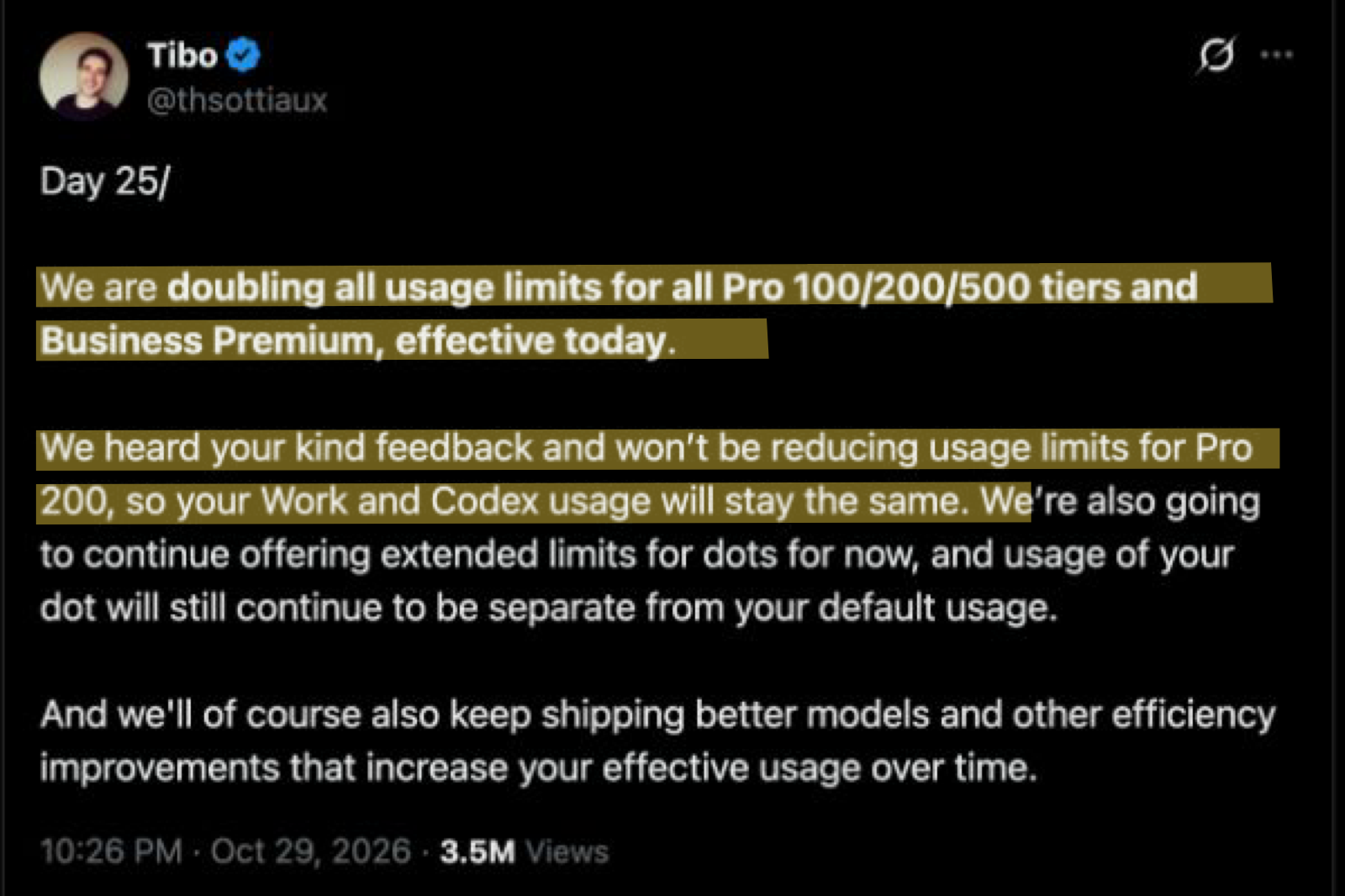
Tibo’s October 29 post. Highlights added. Image: Tibo
On October 29, OpenAI’s Thibault Sottiaux, also known as Tibo, announced the changes on X. OpenAI has since updated its Pro plan help page with the details.
The increase applies to the allowance used in ChatGPT Work and Codex. Codex is OpenAI’s coding tool, which can help with tasks like reading a codebase, making changes and running checks. If you’ve ever had a long task stop because you reached your usage limit, this is the part you’ll care about.
But there’s an important difference between the plans. Not every Pro 200 subscriber gets twice what they personally had before.
The numbers below compare the reported Work and Codex allowance with ChatGPT Plus as the 1x baseline. This is a comparison of usage allowances, not a promise of the same number of messages or tasks on every model.
| Plan | Monthly price | Reported allowance | What changed |
|---|---|---|---|
| ChatGPT Plus | $20 | 1x | Baseline. Plus usage is unchanged. |
| Pro 100 | $100 | About 10x | Previously reported as 5x; its allowance doubled. |
| Pro 200 | $200 | About 20x | The earlier 20x level was cut to a reported 10x for new subscriptions. The planned cut for eligible existing users was canceled, and the lower allowance doubled to match. |
| Pro 500 | $500 | About 50x | The allowance doubled. Tibo also answered yes when asked if Pro 500 was getting 50x usage. |
OpenAI’s help page confirms the doubling and the Pro 200 reversal, but does not list the exact Plus multipliers. The 5x and 20x earlier baseline and the resulting comparisons are drawn from the reported plan history, and Tibo’s 50x reply on X is to a question that does not itself identify the baseline. Treat the figures as an approximate guide, not a published fixed message count.
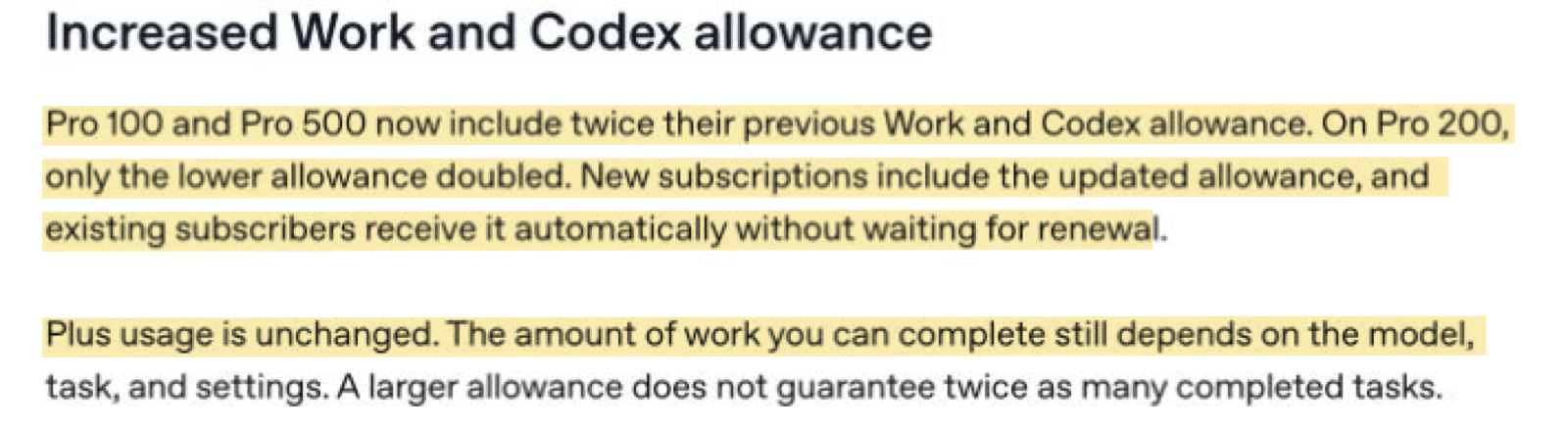
OpenAI’s Work and Codex allowance explanation. Highlights added. Image: OpenAI
There’s the part that caused confusion. Someone who already had the higher Pro 200 allowance does not get another doubling on top of it. A subscriber on the lower allowance gets the increase to match the higher level.
OpenAI says existing subscribers receive the updated allowance automatically. You don’t have to wait for your next renewal or cancel and subscribe again.
ChatGPT Plus usage is unchanged. The company also says that how much work you can get done depends on the model, the task and the settings you choose. Twice the allowance doesn’t necessarily mean twice as many completed tasks.
What happened to the planned Pro 200 cut?
OpenAI had previously told some Pro 200 subscribers that their higher Work and Codex allowance would be reduced after October 29. That reduction has now been canceled. If you had the higher allowance already, you keep it. If you were on the lower allowance, it has increased to match.
That’s a useful change for anyone who had been planning their work around a smaller allowance. New Pro 200 subscriptions also receive the updated allowance, according to OpenAI’s help page.
The weekly GPT-6 Pro message limit in Chat is separate from the Work and Codex allowance. OpenAI says the lower Pro 200 chat limit now matches the higher one; the Pro 100 and Pro 500 weekly chat limits stay as they were. So I wouldn’t assume that the Codex increase changes every limit on your account.
Does this give Pro 200 users Ultrafast?
No. Among the Pro plans, Ultrafast is included with Pro 500. The extra Pro 200 allowance doesn’t unlock it. OpenAI also notes that Fast and Ultrafast modes consume the included allowance at different rates, so check the speed setting if your usage is disappearing quicker than expected.
For the supported GPT-6 Astra and GPT-6.1 Sol models, OpenAI lists Fast at 2.5 times the Standard allowance rate and Ultrafast at 8 times the Standard allowance rate. Purchased credits have their own rates. You can find the current details in the same Pro plan help page.
If you’re using a coding agent with a GitHub repository, my guide on keeping secrets safe around AI coding agents covers another part of the setup that’s easy to overlook.
Google announces Gemini 4 Carbon
Image: Google
Google announced Gemini 4 Carbon on October 28. Google describes it as its strongest model and says it has focused on coding, cybersecurity and longer tasks that require several steps.
The examples Google gives include finding and fixing bugs across large codebases. It also says its internal teams have seen the model work on engineering tasks for days. Those are Google’s own claims, though, and I would wait for broader access and independent testing before deciding how well they hold up for your work.
There’s a catch if you want to try it today. Google says the first rollout starts with a subset of cyber defenders, followed by additional trusted partners through its Fairwind Program. It plans to bring Carbon to developers, businesses and consumers later, but the announcement doesn’t give a general release date.
So if you open the Gemini app and don’t see Carbon, that doesn’t mean there’s a setting you missed. The wider rollout is still to come.
How much will Gemini 4 Carbon cost?
Google says the introductory API price will be $2 per million input tokens and $10 per million output tokens. After the introductory period, the listed price rises to $4 and $20 respectively. Google hasn’t specified an end date for that introductory period in its announcement.
Those are API prices for developers. They aren’t the price of a Gemini app subscription, and they shouldn’t be compared directly with a monthly ChatGPT Pro plan. API costs depend on the amount of input and output your application sends.
Google also published benchmark scores for Carbon, including cybersecurity tests. Benchmarks are useful for seeing what a company measured, but they don’t tell you how a model will handle your own project or whether its safeguards will allow a specific task. I wrote more about that in my guide to reading AI model leaderboards.
What can you try while you wait for Carbon?
Gemini 4 Argon is already available in the Gemini app for Google AI Pro and Ultra subscribers, according to Google’s October 13 announcement. Google also introduced a tasks option that lets Gemini work on supported tasks beyond a regular chat.
If you’re considering a subscription just for a new model, I’d first compare it against the jobs you already do. My post on practical things to try with Gemini 4 Argon has a starting point.
Claude news: drug research, Haiku 5.5 and API credits
Image: Anthropic
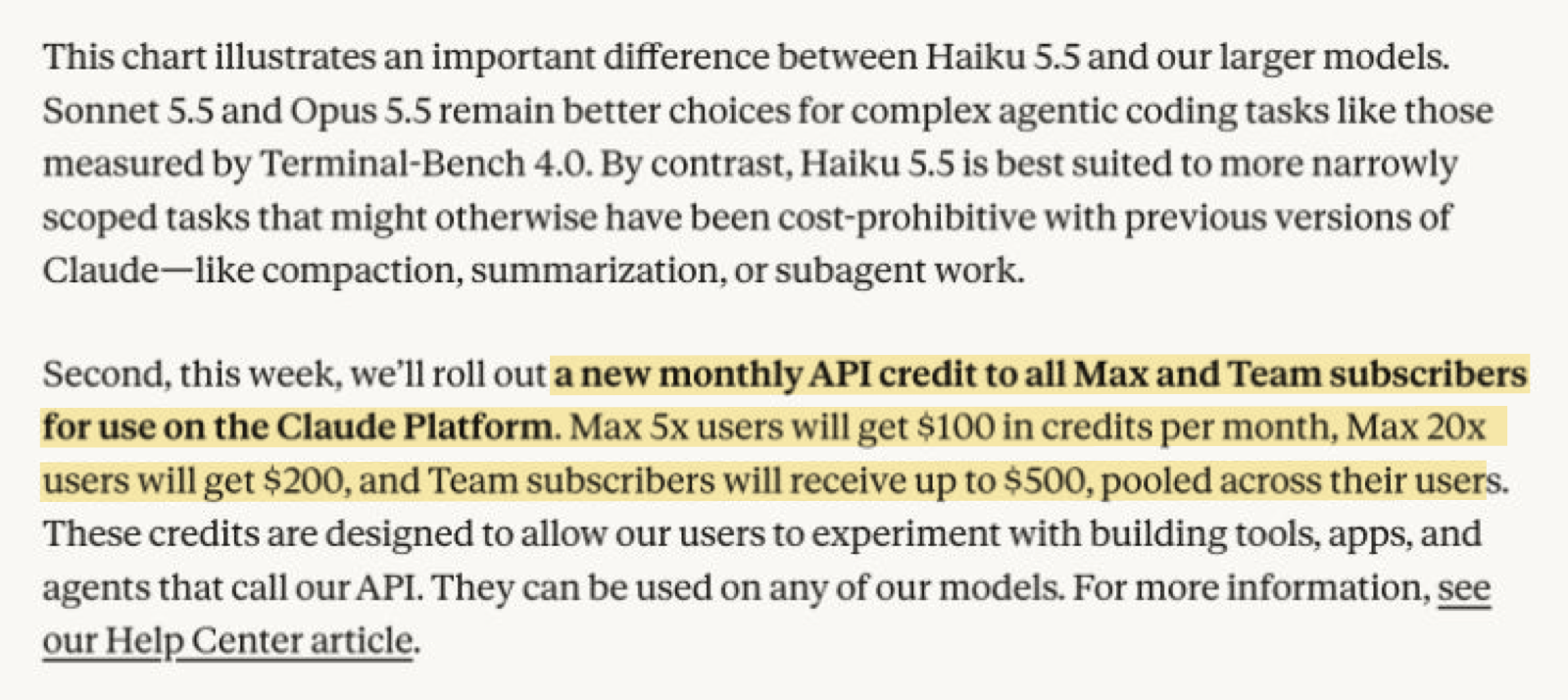
Anthropic’s Claude Haiku 5.5 announcement. Highlight added. Image: Anthropic
Anthropic’s newest Claude news isn’t just about another model release. On October 27, the company shared early progress on using Claude in drug development research, describing partnerships with six organizations working on medicines. On October 28, it also announced an expansion of its AI for Science work with research groups and foundations.
These are research partnerships, not an announcement that Claude has independently produced an approved medicine. The work is at an early stage, and the announcement doesn’t mean you should use Claude in place of a doctor or rely on its answers for treatment decisions.
For developers, the more immediately useful Claude update may be Claude Haiku 5.5, which Anthropic introduced on October 7. This is an earlier October release, rather than an announcement from this week, but its pricing and credits are relevant if you’re comparing what you get from the competing services.
Anthropic positions Haiku 5.5 as a smaller, faster model for repeated jobs such as summaries, classification and browser use. It can also work alongside larger models on parts of a coding task. Anthropic says Sonnet 5.5 and Opus 5.5 remain better choices for more complex coding work.
What does Claude Haiku 5.5 cost?
For API prompts of up to 100,000 tokens, Anthropic lists Haiku 5.5 at $0.10 per million input tokens and $0.50 per million output tokens. Above that prompt size, it lists $0.50 and $2.50 respectively. Cache reads and writes have separate prices.
That’s API pricing, so the bill depends on what your application sends and receives. It isn’t the monthly price of Claude Max, and it doesn’t mean you get unlimited use in the Claude app.
Anthropic also announced monthly Claude Platform API credits for Max and Team subscribers: $100 for Max 5x, $200 for Max 20x, and up to $500 pooled across Team users. Check Anthropic’s announcement and the linked help page for the current eligibility and terms before relying on the credits for a project.
OpenAI models are coming to Google Cloud
This one caught my attention because OpenAI and Google compete directly with ChatGPT and Gemini. On October 21, the companies announced that OpenAI models and Codex workflows would be available through Google Cloud’s Model Garden.
Google Cloud says GPT-6 Astra, GPT-6.1 Sol and GPT-6 Luna are rolling out in private preview to selected enterprise customers. It also says customers can connect local Codex CLI and Desktop workflows to Google’s platform for inference. OpenAI’s announcement describes the same partnership.
For a business already using Google Cloud, this offers another way to work with OpenAI’s models in its existing cloud environment. It doesn’t mean the regular Gemini app has suddenly become ChatGPT, or that every Google Cloud customer has access today.
Which update should you pay attention to?
If you’re a ChatGPT Pro subscriber and use Codex often, check your plan first. The allowance change is already described in OpenAI’s help documentation, and existing subscribers don’t need to resubscribe to receive it.
If you use Gemini, Carbon is the announcement to watch, but Argon is the model Google has made available in the app for eligible subscribers. I wouldn’t buy a subscription expecting immediate Carbon access.
And if you build with Claude’s API, Haiku 5.5’s pricing and the announced credits are worth checking against your actual usage. A cheaper small model can make sense for repeated summaries or classification, while a larger model may be more appropriate when the task needs deeper work.
My advice is to pick a task you already do, run the same job with the tools you can access, and check the result yourself. A larger quota or a new model name is useful only if it helps with the work in front of you.
Frequently asked questions
Did OpenAI double Codex usage for every Pro subscriber?
Pro 100 and Pro 500 received twice their previous Work and Codex allowance. For Pro 200, the lower allowance doubled to match the higher one. Subscribers who already had the higher allowance keep it, rather than receiving another doubling.
Did ChatGPT Plus get a higher Codex allowance?
No. OpenAI says Plus usage is unchanged as part of this update. The increases described here apply to the Pro plans and concern Work and Codex usage.
Can I use Gemini 4 Carbon in the Gemini app now?
Google’s initial Carbon rollout is limited to a subset of cyber defenders and will expand to trusted partners. It plans wider access later, but hasn’t announced a general release date in its launch post.
Is Claude Haiku 5.5 the same as a Claude Max subscription?
No. Haiku 5.5 is a model; Claude Max is a subscription. The per-token rates in this article are API prices for developers. Anthropic separately announced monthly API credits for eligible Max and Team subscribers.
That’s everything I would keep an eye on for now. Which of these tools do you use most, and have you noticed the new Codex allowance on your plan? Let me know which plan and model you’re using, and what kind of work you do with it.