 Dibyajyoti Kabi
Every few weeks a new AI model launches with a chart that says it’s the best in the world. Then another company does the same thing a week later.
So which one is actually the best? The honest answer is that it depends on what you’re asking it to do, and on which leaderboard you look at.
In this post, I will explain how the main AI rankings work, what their numbers really mean, and how I pick a model for my own work.
There are three kinds of rankings
Almost every AI leaderboard falls into one of three groups.
- Human preference. Real people compare two answers and vote for the better one.
- Test scores. Models take a fixed set of exams, like math, science or reasoning questions, and get a score.
- Real tasks. Models try to finish actual work, like fixing a bug in a real code repository, and they either pass or fail.
Each type answers a different question. That’s why a model can top one board and sit in fifth place on another.
Arena: the one everyone quotes
The most famous ranking is Arena, which started as Chatbot Arena and was later called LMArena. It now lives at arena.ai.
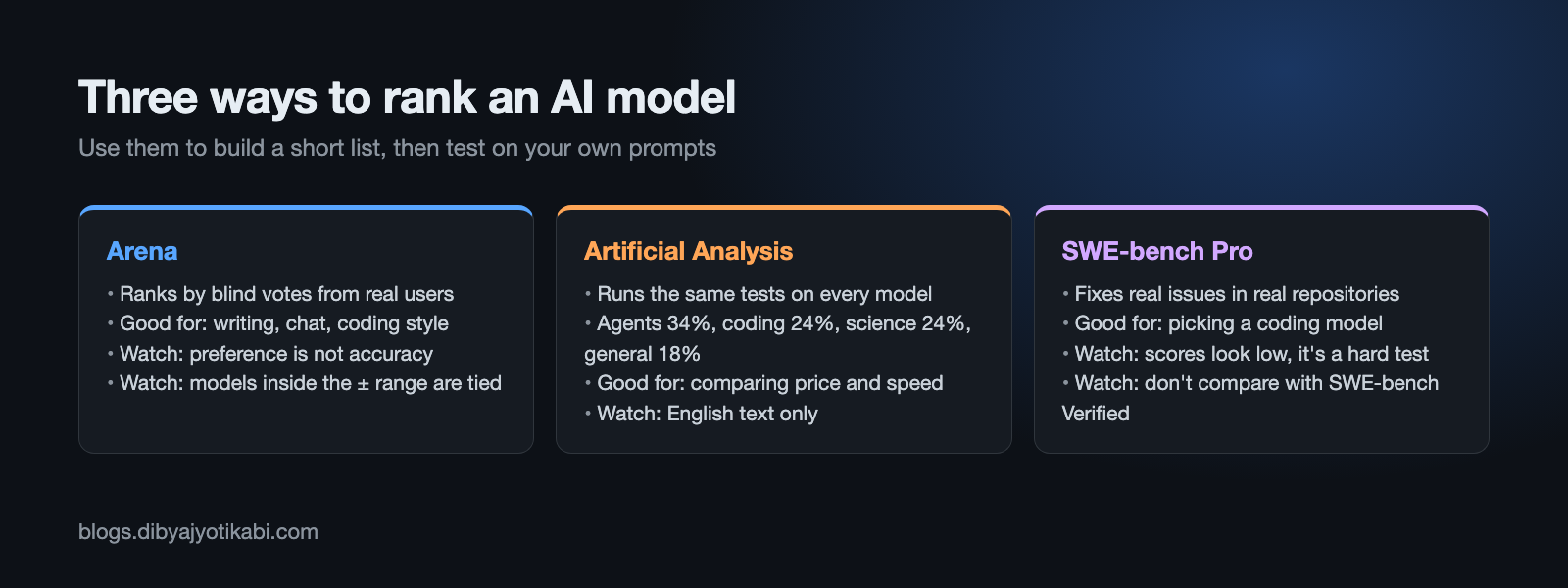
Here’s how it works. You type a prompt, two anonymous models answer, and you vote for the one you like better. Only after you vote do you see which models they were. Millions of these blind votes are turned into a rating for each model, the same way chess ratings work.
It’s a clever setup because nobody can game the questions. People ask whatever they want.
There are a few things to keep in mind, though.
- It measures what people like, not what’s correct. A confident, nicely formatted answer can win even when a plainer one is more accurate.
- Look at the plus or minus number next to each score. If two models are within that range of each other, they’re basically tied.
- Check the category. Arena has separate boards for text, coding (WebDev), vision, search, image generation and more. The overall text winner is often not the best at building websites.
So when a company says “number one on LMArena”, ask which board, and by how much.
Artificial Analysis: the test score average
Artificial Analysis runs the same set of tests on every model itself and combines them into one number called the Intelligence Index.
The current version weighs four areas. Agent tasks count for 34%, coding for 24%, scientific reasoning for 24% and general knowledge for 18%. It uses tests like Humanity’s Last Exam, GPQA Diamond and Terminal-Bench.
I like it for two reasons.
- They run the tests themselves instead of copying numbers from the model maker’s blog.
- They also track speed and price per million tokens. That matters a lot when you’re paying for an API.
The weakness is that it only covers English text. Images, voice and other languages are measured separately.
SWE-bench: the coding test that had to change
SWE-bench gives a model a real issue from a real open source project and checks whether its fix passes the tests. For a long time, SWE-bench Verified was the coding number every lab put in its launch post.
That changed this year. In February 2026, OpenAI said it would stop reporting SWE-bench Verified scores (OpenAI). Its team found that many of the hardest problems had flawed tests, and that some models could repeat the original fixes from memory because they’d seen them during training.
The newer SWE-bench Pro is harder and was built to avoid that problem, so scores on it look much lower. Don’t be surprised when a model scores 80% on one and under 50% on the other. They’re different tests.
Why the numbers can mislead you
Here’s why I never pick a model from a leaderboard alone.
- Contamination. If test questions leak into training data, the model memorizes answers instead of solving problems.
- Cherry-picking. Launch posts show the benchmarks where the model wins and skip the ones where it doesn’t.
- Special settings. Some scores use maximum “thinking” time or many attempts per question. The version you use in the app may not run that way.
- Small gaps. A difference of 1% or a few rating points is usually noise.
- Your task is not the benchmark. A model that aces graduate physics may still write dull blog intros.
How I actually choose a model
This is the process I use, and you can copy it.
- Use the leaderboards to make a short list of three or four models, not to pick a winner.
- Check the right category. For coding, look at Arena’s WebDev board and SWE-bench Pro. For writing, look at Arena’s text board.
- Check the price and speed on Artificial Analysis if you’ll use the API.
- Write five prompts from your real work. For me that’s a blog outline, a bug fix, an email, a summary and a tricky question about my own niche.
- Run the same five prompts on every model on your list and compare side by side.
- Pick the one that wins on your prompts, even if it’s not number one on the board.
It takes about an hour, and it’s the most reliable test there is because it’s based on what you actually do.
Wrapping up
That’s it. Arena tells you what people prefer, Artificial Analysis tells you how models score on hard tests, and SWE-bench Pro tells you how they handle real code. None of them tells you which model is best for you.
Which AI model do you use most right now, and for what kind of work? Let me know in the comments and I’ll tell you which leaderboard is most useful for your case.