 Dibyajyoti Kabi
If you run a blog and your Google traffic has been sliding, you’ve probably blamed AI Overviews at least once. I’ve had the same thought looking at my own sites.
But a feeling isn’t data. So I went looking for a study that measured real searches by real people, not a vendor’s guess. The best one I found comes from Pew Research.
In this post, I will walk you through what Pew found, what it means for small blogs, and the changes I’m making to how I write.
What Pew measured
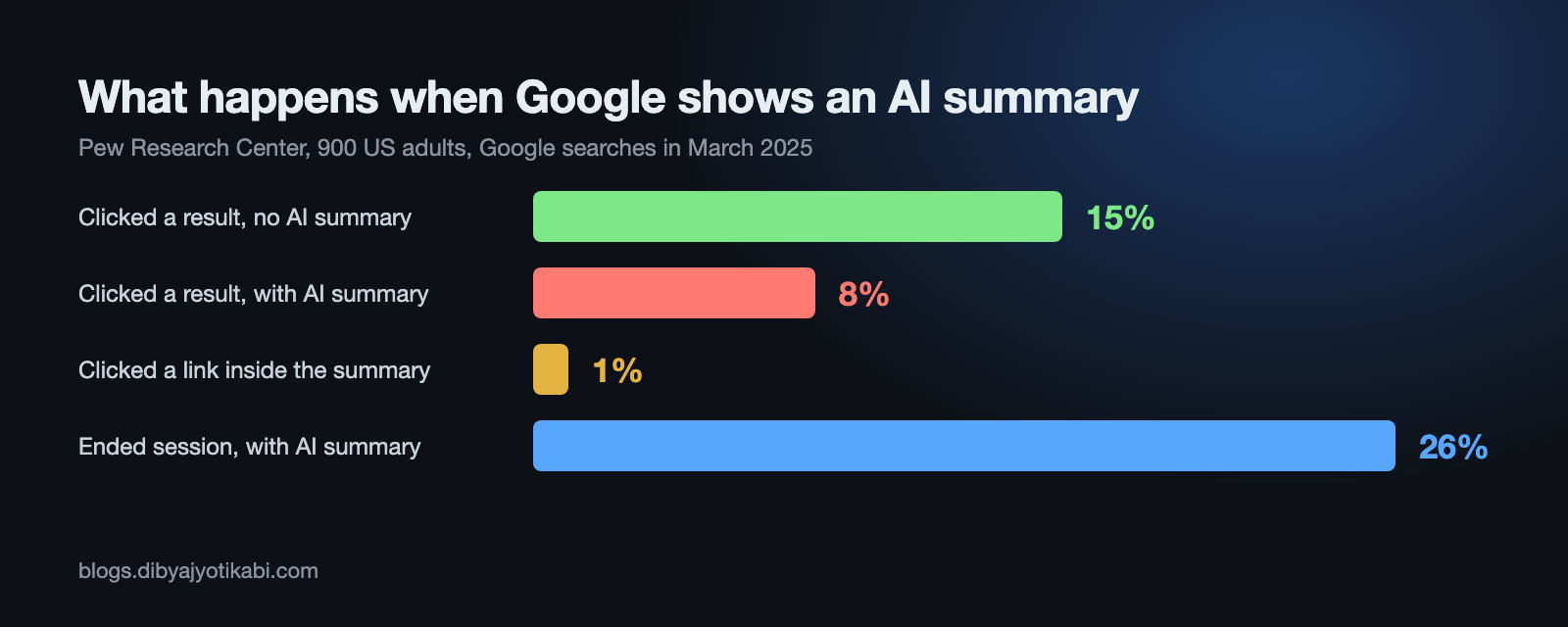
Pew Research published the study on July 22, 2025. It tracked the browsing of 900 US adults who agreed to share their activity, and looked at their Google searches in March 2025.
That’s what makes it useful. It’s not a survey asking people what they think they do. It’s what they actually clicked.
The numbers
Here’s what stood out to me.
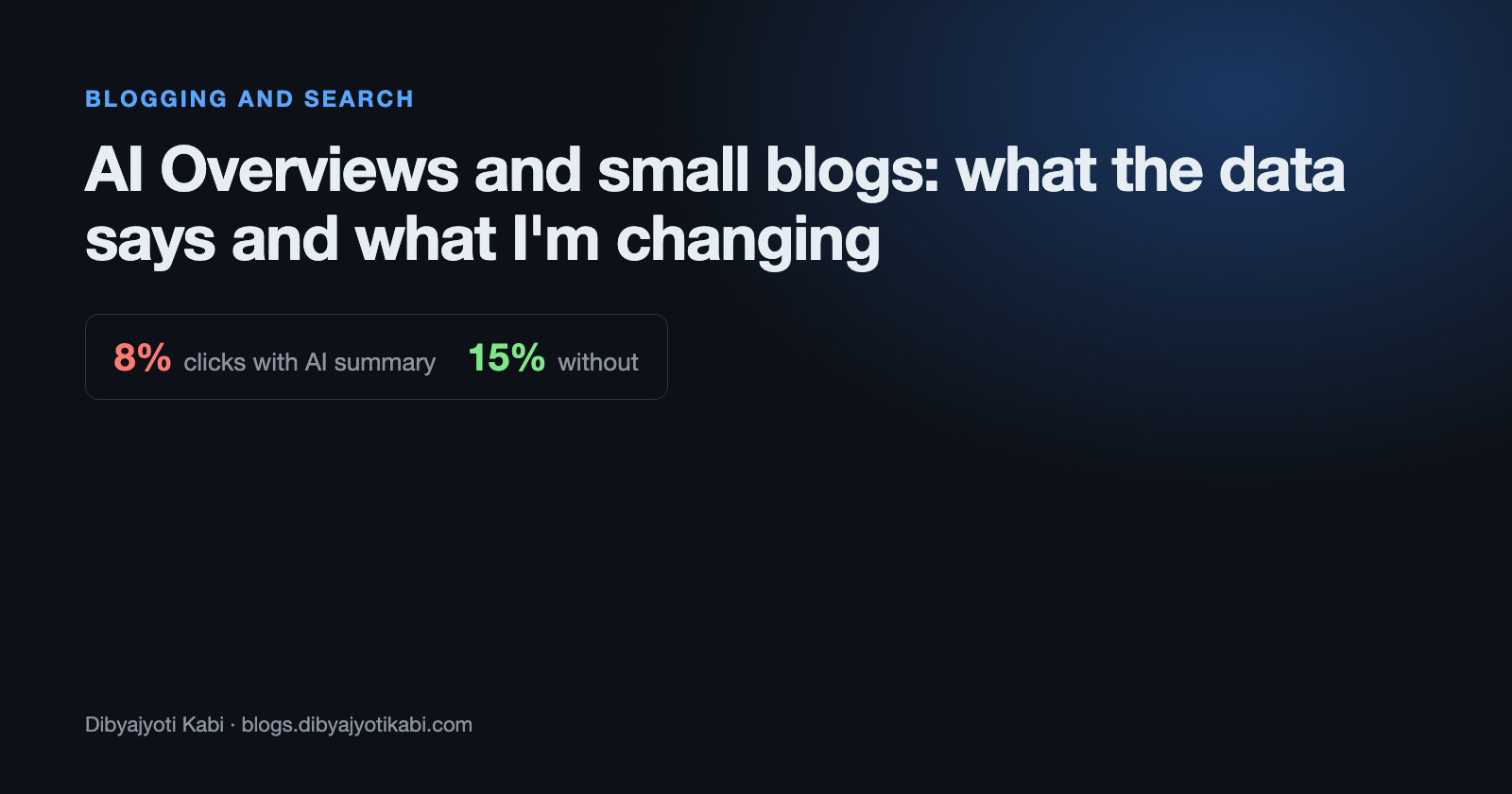
- When a search showed an AI summary, people clicked a regular result on 8% of visits.
- When there was no AI summary, they clicked a result on 15% of visits.
- People clicked a link inside the AI summary itself on just 1% of visits.
- 26% of searches with an AI summary ended the browsing session right there, compared with 16% of searches without one.
So the click rate roughly halves when an AI summary appears. And the links inside the summary, the ones that are supposed to send you traffic, barely get clicked at all.
What it doesn’t tell you
Be careful not to read too much into it. The data is from March 2025 and US users only. AI Overviews have changed a lot since then, and they show up on more searches now.
It also doesn’t say which kinds of searches lost the most. My guess, based on what I see, is that quick-answer queries get hit the hardest. Things like “what does CSC mean on Samsung” can be answered in two lines. A step-by-step guide with screenshots is harder to replace.
That’s a guess though, not a finding. I’d rather tell you that than dress it up.
What I’m changing
I’m not going to stop writing. But I am changing what I write and how.
- Fewer posts that answer one simple question. If a two-line AI summary can fully replace my post, it probably will.
- More first-hand stuff. Things I tested myself, real build numbers I pulled, tools I built and what broke along the way. A summary can repeat facts, but it can’t repeat my experience.
- Better images. Diagrams and screenshots I make myself give people a reason to open the actual page.
- A clear point of view. I say what I’d do and why. Summaries tend to average everything out.
- Direct ways to come back. An email list and links between related posts matter more when search is less reliable.
- Staying visible in AI search. I don’t block the search crawlers from OpenAI and Anthropic, so my posts can still be cited with a link. I wrote about which AI bots to block and which to allow if you want the details.
Should you opt out of AI Overviews?
You can’t, not without leaving Google Search entirely. AI Overviews are part of Search, and blocking Googlebot removes you from both.
Google does offer snippet controls like nosnippet and max-snippet, which limit how much of your text Google can show. But they also limit your normal search snippets, so they can hurt more than they help. For most small blogs, I wouldn’t touch them.
Wrapping up
That’s it. The data says AI summaries cut clicks roughly in half, and the citation links inside them barely help. The answer, at least for me, is to write the kind of posts a summary can’t replace.
Have you seen your blog traffic change since AI Overviews rolled out? Tell me what niche you write in and roughly how your clicks have moved, and I’ll share what I’d try.