 Dibyajyoti Kabi
When people hear “AI career”, they picture someone with a PhD training giant models. Those jobs exist, but they’re a tiny slice of the work.
Most of the AI work happening right now is much more practical. Someone has to connect AI tools to a business, set them up properly, check what they produce and teach the team to use them.
In this post, I will show you the AI roles you can actually get into without a computer science degree, what to learn for each one, and a simple 90-day plan to get started.
Why now is a good time
The World Economic Forum’s Future of Jobs Report 2025 lists AI and big data as the fastest-growing skills through 2030 (WEF). The same report expects 170 million new jobs and 92 million lost by 2030, a net gain of 78 million, and says employers expect close to 40% of core skills to change.
In plain terms, a lot of jobs are being reshaped, and companies need people who understand AI tools and the business at the same time. That’s a gap you can fill without writing research papers.
Five AI roles that don’t need a CS degree
These are the paths I see real demand for, especially with small and mid-sized businesses.
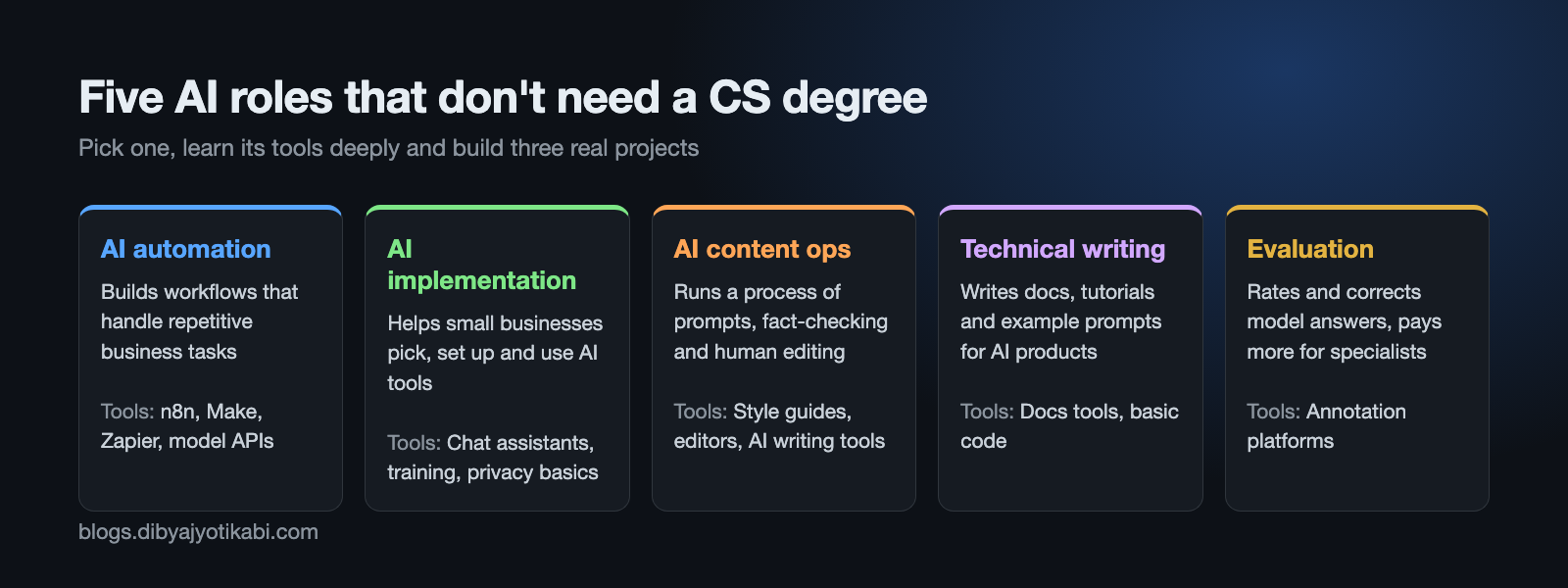
1. AI automation specialist
You build workflows that do repetitive work for a business. For example, a new lead fills a form, AI writes a first reply, the details go into a spreadsheet or CRM, and the sales team gets a message.
Tools to learn are n8n, Make or Zapier, plus the API of at least one AI model. This is one of the easiest roles to sell to clients because the time saved is easy to measure.
2. AI implementation consultant for small businesses
Most small businesses know they “should use AI” but have no idea where to start. You audit how they work, pick two or three tasks where AI actually helps, set up the tools and train the staff.
You need good communication, a solid understanding of what current AI tools can and can’t do, and basic privacy awareness. Industry knowledge helps a lot here. If you’ve worked in a clinic, a shop or an accounting office, start with that type of business.
3. AI content and operations
Companies are producing more content with AI, and much of it is bad. People who can set up a good process, with prompts, style guides, fact-checking and human editing, are in demand.
If you already write, edit or manage social media, this is the shortest path into AI work.
4. Technical writer for AI products
AI tools need documentation, help articles, tutorials and example prompts. If you can explain technical things in plain language, this pays well and doesn’t require coding beyond the basics.
5. Data annotation and AI evaluation
AI companies pay people to rate answers, write example responses and check model output for mistakes. Specialists in medicine, law, finance or coding get paid more.
It’s a good way to earn while learning, but treat it as a stepping stone. The work comes and goes.
What to learn first
Whatever role you pick, these basics apply to all of them.
- Use AI tools every day. ChatGPT, Claude, Gemini and Perplexity each have strengths. Learn where each one fails, not just where it shines.
- Learn the core ideas. Free courses like DeepLearning.AI’s AI for Everyone cover what AI is and isn’t in plain language.
- Learn basic Python if you want the technical roles. You don’t need to be a developer, but reading and changing a simple script opens a lot of doors.
- Learn how APIs work. Almost every automation job comes down to sending data from one tool to another.
- Go deeper only if you enjoy it. The free Hugging Face courses and fast.ai are excellent next steps if you want to understand how models work.
Here’s why the basics matter so much. In the 2025 Stack Overflow survey, the top frustration developers had with AI tools was answers that are almost right but not quite (Stack Overflow). Spotting “almost right” is a skill, and employers pay for it.
Build proof, not certificates
Certificates help a little. Real projects help a lot more.
Pick three projects that match the role you want.
- For automation, build a workflow that handles your own email, invoices or social posts, and record a short video showing it working.
- For implementation, help a friend’s business set up AI for one task, then write down what changed. “Saved four hours a week on customer replies” is a great line on a portfolio.
- For content, take a weak AI-written article, edit it properly and show the before and after.
- For any role, write about what you’re learning. A small blog or LinkedIn posts with real examples will get you noticed faster than a résumé.
A simple 90-day plan
- Days 1 to 30. Pick one role. Use AI tools daily, finish one beginner course and write down five tasks in your current job or life that AI could help with.
- Days 31 to 60. Build two projects from that list. Share what you built online, including what went wrong.
- Days 61 to 90. Offer to do one project for a real business, paid or at a low price. Use that result to pitch the next client or apply for jobs.
That’s it. Ninety days won’t make you an expert, but it will put you ahead of most people who are still just reading about AI.
A word of caution
Be careful with anyone selling a “become an AI engineer in 30 days” course for a big fee. Most of what you need is free. Spend money on tools and time, not on hype.
Wrapping up
You don’t need a degree or advanced math to build a career in AI. Pick a practical role, learn the tools deeply, build real projects and show your work. Businesses need people who can make AI useful, and right now there aren’t enough of them.
What do you do right now, and which of these five roles feels closest to it? Tell me your background in the comments and I’ll suggest the best first project for you.