 Dibyajyoti Kabi

Search “make money with AI” on YouTube and you’ll find hundreds of videos promising easy income. Most of them are selling a course, and the method only works for the person selling it.
But there is real money in AI skills. It just looks less like a magic trick and more like a normal service business that uses AI to work faster.
In this post, I will show you seven ways people are actually earning with AI right now, what you need to start each one, and the traps to stay away from.
The rule that makes all of these work
Here’s the one idea behind every method on this list. Clients don’t pay for AI. They pay for a result, like more leads, saved time or a finished product. AI is just how you deliver it faster.
If you sell “I’ll use ChatGPT for you”, you’ll compete with a free tool. If you sell “I’ll cut your customer reply time in half”, you have a business.
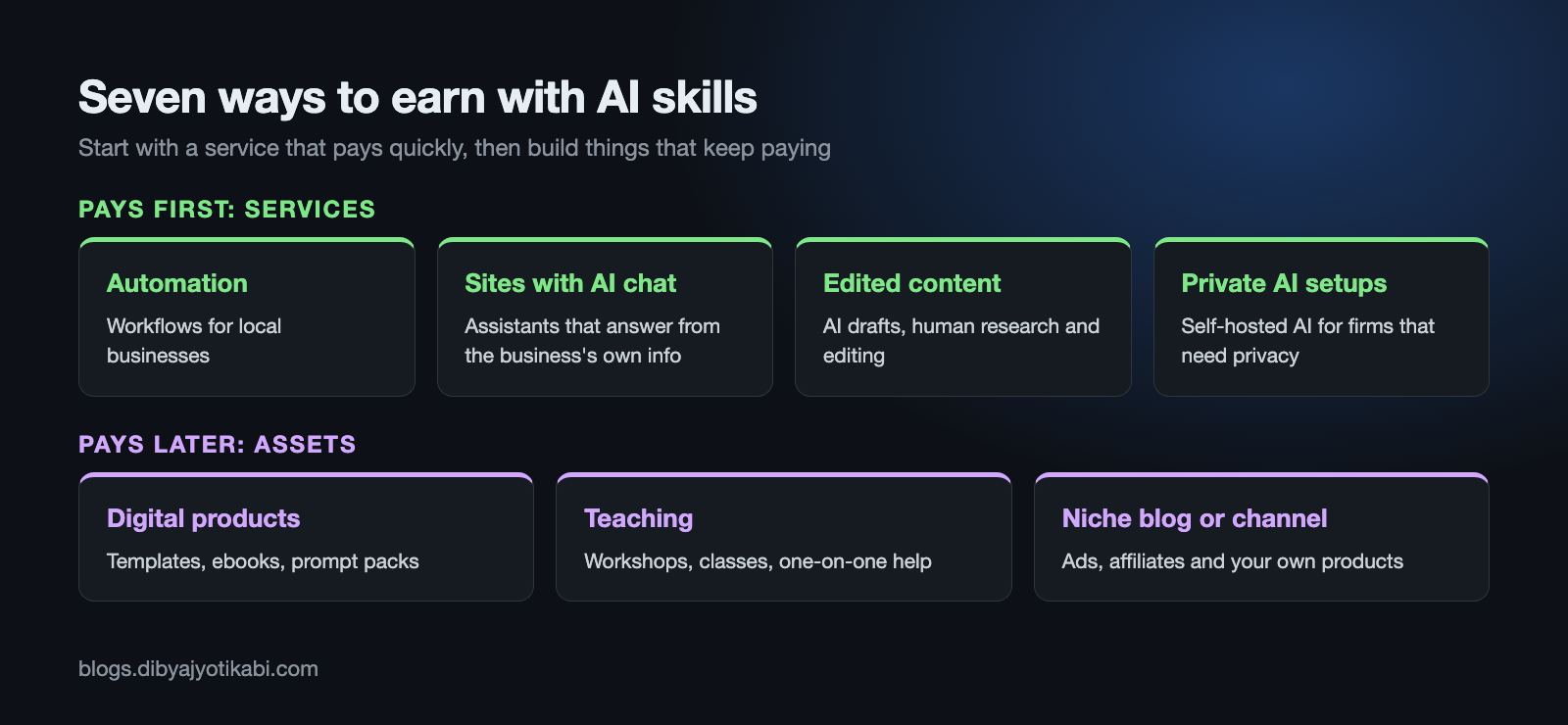
1. Automation for local businesses
Clinics, real estate agents, coaching centers and small shops waste hours on the same tasks. Answering the same questions, copying leads into spreadsheets and sending reminders.
You build automations with tools like n8n or Make that handle that work, with AI writing replies or summaries where it helps. Charge a setup fee, then a monthly fee to maintain it.
What you need is a solid grasp of one automation tool, an AI model’s API and a few demo workflows. My post on building an AI career without a CS degree covers how to learn this.
2. Websites with AI assistants built in
Lots of businesses still need a website, and now many also want a chatbot that answers customer questions from their own information.
If you can build sites, adding an AI assistant trained on the business’s FAQ, prices and policies is an easy upsell. Just make sure it says “I don’t know” instead of making things up, and test it hard before launch.
3. Content services with real human editing
AI can draft quickly, but raw AI content is usually generic and sometimes wrong. Businesses need someone who can turn a draft into something accurate and useful.
Offer blog posts, product descriptions, newsletters or social content, where AI helps with research and drafts and you do the thinking, fact-checking and editing.
Be careful here. Google’s spam policies specifically call out scaled content abuse, which means mass-producing pages mainly to rank, whether by AI or by people (Google Search Central). Clients who ask for 500 AI articles a month are asking you to hurt their site.
4. Private AI setups for businesses
Some businesses, like law firms, clinics and accountants, want AI but don’t want client data going to a public chatbot. You can set up a private AI chat on their own server.
I wrote a full guide on self-hosting Ollama and Open WebUI on a VPS. Charge for setup, user training and a monthly maintenance plan. This one needs some Linux comfort, but very few freelancers offer it, so you can charge more.
5. Digital products
Templates, prompt packs, Notion systems, planners, worksheets and ebooks can all sell for years after you make them. AI speeds up the creation, but the value comes from your experience and how well the product solves one specific problem.
I did this myself with Blog to Paycheck, a 107-page ebook on starting a blog and earning from it. The key was writing from what I’d actually done, not from what an AI thought blogging was.
Digital products are slower to start. You need an audience or traffic first, which is why many people start with a service and build products on the side.
6. Teaching AI to others
Teachers, small business owners, office workers and retirees all want to use AI but don’t know where to begin. You can run local workshops, teach small online classes or offer one-on-one sessions.
You don’t need to be the world’s top expert. You need to be a few steps ahead and good at explaining things simply.
7. A niche blog or YouTube channel
Pick a topic you know well and help people with it, using AI to speed up research, outlines and editing. Earn through ads, affiliate links and your own products.
This is the slowest path on the list. Expect six months to a year before meaningful income. But it builds an asset you own, and it feeds every other method above.
How much can you charge?
Prices vary a lot by country and client size, so I won’t throw out made-up numbers. Here’s a simple way to set yours.
- Estimate how many hours or how much money your work saves the client each month.
- Charge a fraction of that, so the client clearly comes out ahead.
- Start lower for your first two or three clients in exchange for a testimonial.
- Raise your price with every new client until people start saying no.
Scams and traps to avoid
There’s more money being made selling AI hype than using AI well. Watch out for these.
- Courses promising fixed monthly income. If the method really worked that easily, they wouldn’t need to sell it.
- “Faceless” channel or auto-blog schemes. Mass AI content gets hit by platform and search policies, and the accounts often get demonetized.
- Paying for “AI job” placements or training fees before you get work. Real employers don’t charge you to work for them.
- Crypto and trading bots marketed as AI. Stay away entirely.
- Tools that ask for your passwords or bank details to “automate” your income.
Wrapping up
That’s it. The people earning real money with AI aren’t using secret tools. They pick one problem, solve it well with AI’s help, and charge for the result. Start with a service that pays quickly, then build products and content that keep paying.
Which of these seven sounds closest to what you can do today? Tell me your current skills and where you’re based, and I’ll help you pick the one to start with.