 Dibyajyoti Kabi
“Is web design dead because of AI?” I hear this question almost every week now.
I get why people ask. You can type one sentence into an AI tool and get a full landing page in under a minute. But someone still has to know whether that page is any good, make it fast, make it work for real customers, and fix it when it breaks.
In this post, I will show you what a web design career looks like in 2026, what to learn first, and how to get your first paying clients.
Is it still worth it?
Short answer: yes, if you go beyond the basics.
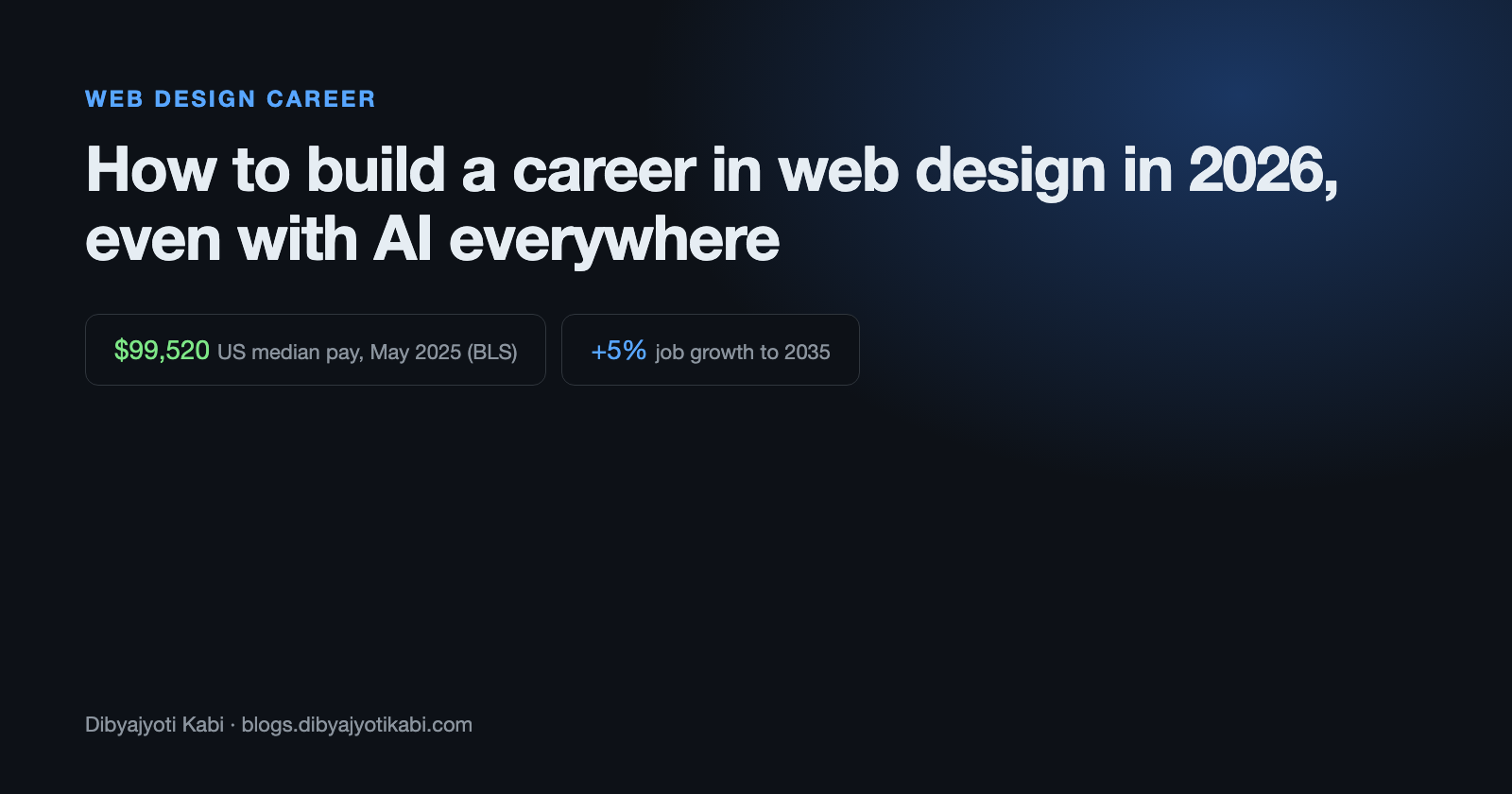
The US Bureau of Labor Statistics puts the median pay for web developers and digital designers at $99,520 a year as of May 2025, with web and digital interface designers at $104,000 (BLS). It expects jobs in the field to grow 5% from 2025 to 2035, which is faster than average, with about 13,600 openings each year.
Those are US numbers, and pay in India or elsewhere is lower in absolute terms. But the trend is the same. Businesses still need websites, and they need people who can make them work.
What has changed is the bottom of the market. Simple five-page brochure sites are now cheap and fast to make with AI and site builders. If that’s all you offer, you’ll compete on price forever.
What the job looks like now
A web designer in 2026 does less pixel pushing and more problem solving.
- Understanding what the business actually needs, which is usually more leads or more sales, not “a nice website”.
- Turning that into a clear layout and content structure.
- Building it, often with AI help, and then fixing what the AI got wrong.
- Making it fast, accessible and easy to find on Google and AI search.
- Maintaining it, which is where the steady monthly income comes from.
AI is now a normal part of the toolkit. In the 2025 Stack Overflow Developer Survey, 84% of developers said they use or plan to use AI tools, but more of them distrust the accuracy of those tools than trust it (Stack Overflow). That gap is your job. Clients need someone who can check the output.
What to learn first
Here’s the order I’d follow if I were starting from zero today.
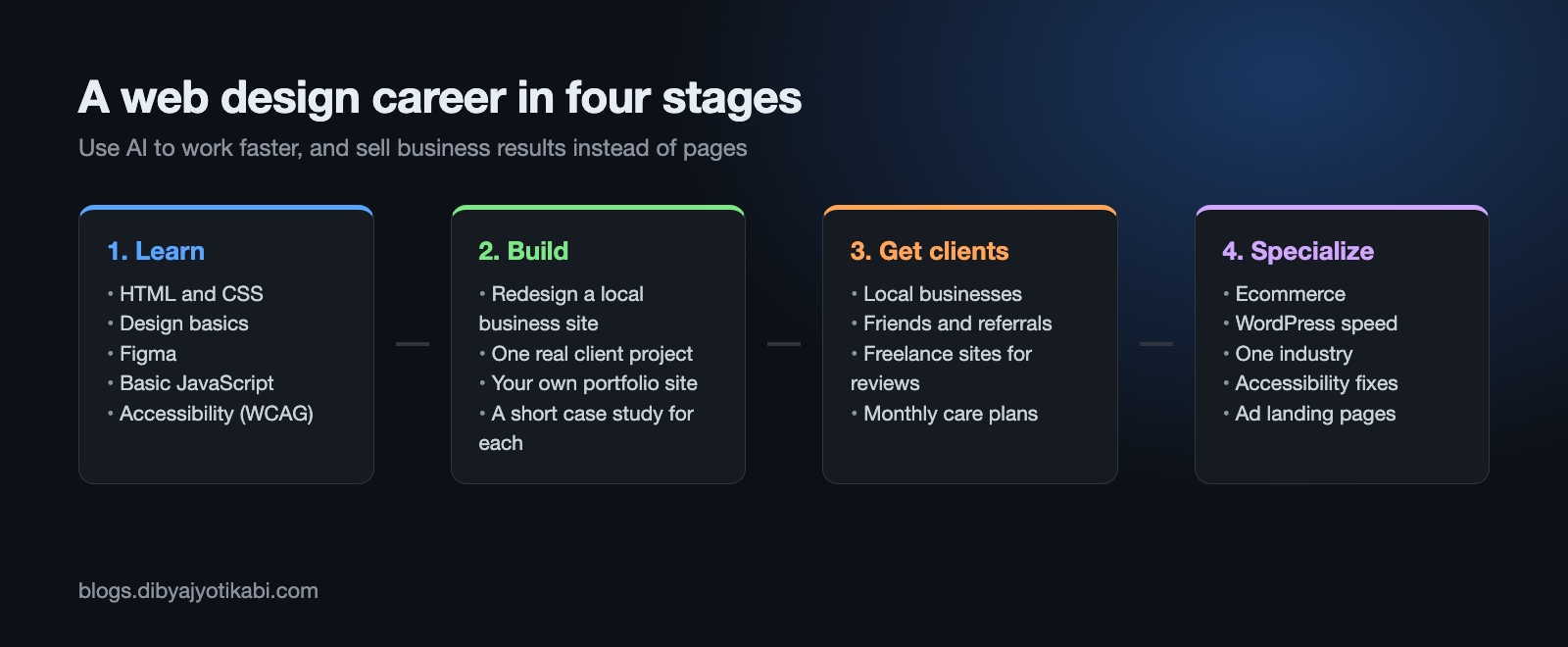
- HTML and CSS. Learn them properly, including Flexbox, Grid and responsive layouts. The free MDN Learn web development course is a great place to start.
- Design basics. Spacing, typography, color and visual hierarchy. Practice by copying the layouts of sites you like.
- Figma. It’s free to start, and it’s what most clients and agencies use for mockups.
- Basic JavaScript. Enough to add menus, forms and small interactions, and to read what an AI tool writes for you.
- One way to ship real sites. WordPress is still the most common choice for small businesses. Webflow or a framework like Astro or Next.js are good options too.
- Accessibility. Learn the basics of WCAG, like color contrast, alt text and keyboard navigation. Many clients don’t know they need it until someone tells them.
- Speed and SEO basics. A beautiful site that loads in eight seconds doesn’t help anyone. My website optimization checklist covers the essentials.
You don’t need a degree for any of this. You need practice and proof.
Build a portfolio that gets work
Most beginner portfolios show the same tutorial projects. Clients can tell.
Instead, build three real projects.
- Redesign a real local business site. Pick a restaurant, clinic or shop near you with an outdated site, and design a better version. Show the before and after.
- Build something for a friend or a nonprofit for free or cheap. A real client, even an unpaid one, teaches you more than any course.
- Make your own site. Your portfolio itself is a project. Make it fast, clean and easy to contact you from.
For each project, write a short case study. What was the problem, what did you change, and what was the result? A sentence like “the new site loads in 1.2 seconds instead of 6” is worth more than ten mockups.
How to get your first clients
This is the part most courses skip.
- Start local. Walk into or message small businesses with bad websites or no website at all. Show them one specific improvement, not a generic pitch.
- Tell everyone you know. Your first few clients almost always come from friends, family and their contacts.
- Use freelance platforms carefully. Upwork and Fiverr can work, but beginner prices there are very low. Use them to get reviews, then move on.
- Partner with others. Marketing freelancers, photographers and SEO people often need someone to build sites for their clients.
- Sell care plans. After you build a site, offer monthly updates, backups and small fixes. Ten clients on a care plan is a stable base income.
Pick a niche after a year
Once you’ve built a few sites, specialize. Generalists compete on price. Specialists get referred.
Some niches that pay well right now are ecommerce stores, WordPress speed and maintenance, sites for one industry like dentists or real estate, accessibility fixes, and landing pages for paid ads.
Wrapping up
That’s it. Web design isn’t dead, but “I can make a website” is no longer enough. Learn the basics properly, use AI to work faster, build real projects, and solve business problems instead of selling pages.
Are you just starting out, or already building sites and trying to grow? Tell me where you are and which country you work in, and I’ll suggest the next skill to focus on.